What handwoven really means, how it differs from woven and non-woven bags, and what to check when sourcing.
Buyers often use “handwoven”, “woven” and “non-woven” as if they describe the same bag. They do not. The three terms describe different production methods, different materials and often different products altogether — and mixing them up at the sourcing stage is one of the most common reasons a brief comes back with the wrong samples.
What “handwoven” actually means
Handwoven means the bag is woven by hand on a frame, a floor loom or with a needle, rather than on an industrial loom. The result is a slightly irregular surface: small variations in tension, density and edge finish are normal and are part of the character of the material. Those variations are also why handwoven bags are specified with a tolerance, not with a promise of pixel-perfect repetition.
Handwoven vs woven
Woven describes the structure: two sets of threads crossing each other. A machine-woven bag is still woven. Handwoven describes who did the weaving. A supplier can quote a “woven bag” that is machine-made, and a “handwoven bag” that uses exactly the same fibre — the construction is similar, the production method and the labour content are not.
Woven vs non-woven
Non-woven is a different product category. It is made from bonded fibres — usually polypropylene — and is common in promotional and packaging bags. It is not a handwoven bag and should not be specified in the same brief. If a supplier quotes “non-woven” when you asked for handwoven, the sample will not match the reference, even if the colour and shape are close.
Why the distinction matters for sourcing
- Minimum order: standard handwoven styles start at 50 pcs per style; new tooling or bespoke hardware may require 100 pcs per style.
- Sampling: first samples usually take 10–15 business days after the specification and materials are confirmed.
- Bulk production: 30–45 business days after sample approval, depending on the order and packaging.
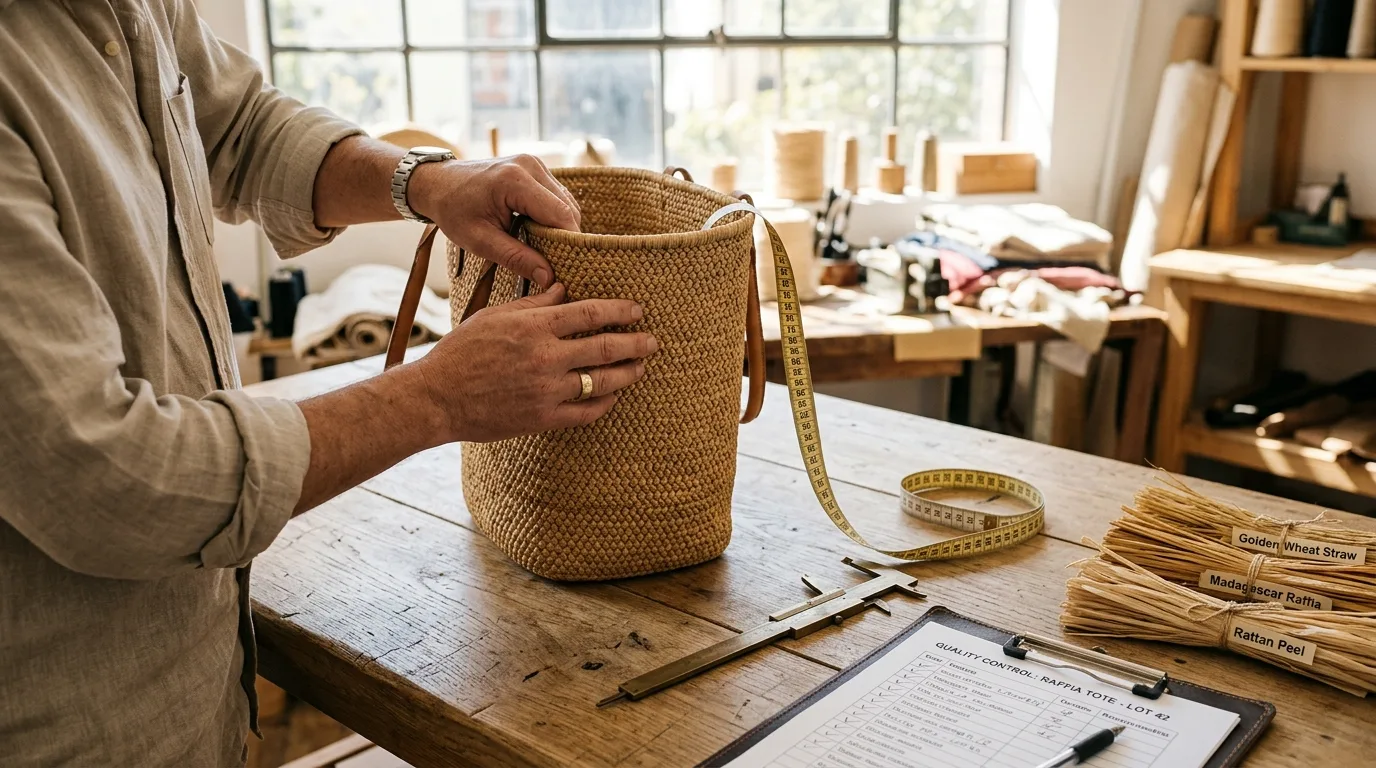
- Inspection: every bag is checked at six production stages and again before packing; third-party inspection can be arranged.
- Natural variation: agree a tolerance for shade, tension and dimensions before the bulk order, not after.
How to specify it in a tech pack
- Fibre: raffia, natural straw, paper cord or crochet yarn — name the fibre, not just the colour.
- Weave: plain, diagonal, open or basket weave, with the density or weight if you have it.
- Dimensions: width, height, depth and handle drop.
- Finishing: lining, handles, hardware, labels and packaging.
- Reference: a photo, a sketch or a physical counter-sample is more useful than a written description alone.
FAQ
Is handwoven more durable than woven?
Not automatically. Durability depends on the fibre, the weave density and the finishing. A tightly woven natural straw bag can outlast a loosely woven one in a different fibre.
Can you combine materials?
Yes. Raffia or straw bodies with leather or wrapped handles, cotton linings and metal hardware are common combinations.
What is the minimum order?
50 pcs per style for standard materials and construction; 100 pcs where new tooling or fully bespoke hardware is required.
Related pages: custom bag manufacturing · handwoven tote bags · private label · wholesale terms